Flexible PIC Concentrators:
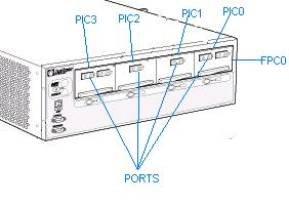
The FPCs contains the Physical interface Cards (PICs) used
in the router and connect them to other router components. FPCs
install into the front of the router in either a vertical or
horizontal orientation, depending on the router.
Physical Interface Cards:
PICs are used to connect to a network media. PICs receive
incoming packets from the network and transmit outgoing packets
to the network. PICs encapsulate the packets received from the
FPCs before transmitting them to the network.
Routing Engine:
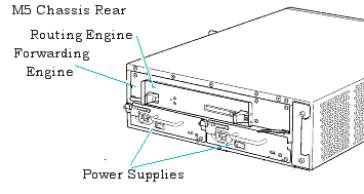
The Routing Engine consists of an Intel-based PCI platform
running the JUNOS software. The Routing Engine maintains the
routing tables used by the router. Routing Engine consists of
a CPU; SDRAM for storage of the routing and forwarding tables
and other processes; a compact flash disk for primary storage
of software images, configuration files, and microcode; a hard
disk for secondary storage; a PC card slot (on some M40 routers,
a floppy disk) for storage of software upgrades; and interfaces
for out-of-band management access.
Power Supplies:
Each Juniper Routers has one, two, or four load-sharing power
supplies. The power supplies are connected to the router midplane
(on an M40 router, to the router backplane), which distributes
the different output voltages throughout the router and its
components. Some routers can operate using either AC or DC power
while the other routers operate with DC power only.
Cooling System:
The cooling system keeps all router components within the
recommended operating temperature limits. If one component of
the cooling system fails or is removed, the system automatically
adjusts the speed of the remaining components to keep the temperature
within the acceptable range. The cooling system for each router
is unique and can consist of fans, impellers, and air filters.