A spectrum analyzer is a wide band, very sensitive receiver.
It works on the principle of "super-heterodyne receiver"
to convert higher frequencies (normally ranging up to several
10s of GHz) to measurable quantities. The received frequency
spectrum is slowly swept through a range of pre-selected
frequencies, converting the selected frequency to a measurable
DC level (usually logarithmic scale), and displaying the
same on a CRT. The CRT displays received signal strength
(y-axis) against frequency (x-axis).
Obviously, signals that are weaker than the background
noise could not be measured by a spectrum analyzer. For
this reason, the noise floor of a spectrum analyzer in combination
with RBW is a vital parameter to be considered when choosing
a spectrum analyzer. The received signal strength
is normally measured in decibels (dbm). (Note that 0 dBm
corresponds to 1 mWatt of power on a logarithmic scale).
The primary reasons for measuring the power (in dBm) rather
than voltage in Spectrum Analyzers are the low received
signal strength, and the frequency range of measurement.
Spectrum analyzers are capable of measuring the frequency
response of a device at power levels as low as -120dBm.
These power levels are encountered frequently in microwave
receivers, and spectrum analyzers are capable of measuring
the device characteristics at that power levels.
A spectrum analyzer displays received signal strength
(y-axis) against frequency ( x-axis). An Oscilloscope, displays
received signal strength (y-axis) against time (x-axis).
Spectrum analyzer is useful for analyzing the amplitude
response of a device against frequency. The amplitude is
normally measured in dBm in Spectrum Analyzers, where as
the same is measured in volts when using Oscilloscopes.
Normally, Oscilloscope can not measure very low voltage
levels (say, -100dBm) and are intended for low frequency,
high amplitude measurements. A spectrum analyzer can easily
measure very low amplitudes (as low as -120dBm), and high
frequencies (as high as 150GHz).
The spectrum analyzer measurements are in frequency
domain, whereas the oscilloscope measurements are in time
domain.
Also, a spectrum analyzer uses complex circuitry compared
with an Oscilloscope. As a result of this, the cost of a
spectrum analyzer is usually quite high.
3.Simplified Block Schematic of Heterodyne Receiver:
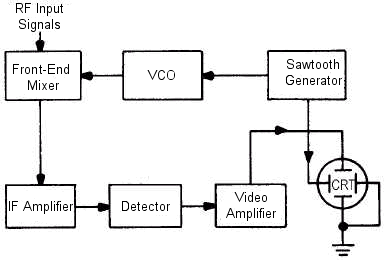
The figure above shows a simplified block diagram of a super-heterodyne
receiver. As seen from the above figure, it consists of the
following parts:
Front-end Mixer
Voltage Controlled Oscillator
Sawtooth Generator
IF Amplifier
Detector
Video Amplifier
Cathode Ray Tube (CRT)
Front-end mixer is where the rf input is combined with the
local oscillator (VCO) frequency to give IF (Intermediate Frequency)
output. The IF frequencies are then fed to the an IF amplifier,
then to a detector. The output of the detector is fed to the
video amplifier. The output from the video amplifier is given
to CRT (vertical axis), and the output of the sawtooth generator
is given to the horizontal axis of the CRT. Thus we see the
signal amplitude against the time sweep (which in turn represents
the frequency).
Normally, the frequency conversion takes place in multiple
stages, and band-pass filters are used to shape the signals.
Also, precision amplifiers, and detectors are used to amplify
and detect the signals.
4.Key Features to Consider When Buying a Spectrum Analyzer:
Resolution bandwidth
Frequency range
Frequency stability
AC/DC Operation
Service warranty
Resolution bandwidth: This is an important parameter
to consider when buying a Spectrum Analyzer. The sensitivity
of the spectrum analyzer is directly dependent on the resolution
bandwidth of the analyzer. If your measurements are over a wide
band, a 3 KHz RBW is normally sufficient. If you need to make
very narrow band measurements (such as filters), then consider
a 300Hz or even a 10Hz RBW spectrum analyzer. Obviously, a spectrum
analyzer with lower RBW costs more than a spectrum analyzer
with 3 KHz RBW. Frequency range: This is the range
of frequencies that you need to make measurements. Spectrum
analyzers are available from 100 Hz to 50 GHz range. If you
require measurements up to, say IF to 2.4 GHz, a spectrum analyzer
from 10MHz-2.4 GHz would be suitable. Frequency Stability:
Frequency stability is the ability of the spectrum analyzer
to maintain the frequencies within a specified accuracy. The
frequency stability is dependent on the Local Oscillator stability
of the spectrum analyzer. For narrow band measurements, this
is a very important parameter. Spectrum analyzers do not normally
have very high stability clock. If high accuracy of measurement
is required, consider buying a spectrum analyzer with provision
for external frequency reference. In such an event, the accuracy
of the spectrum analyzer is as good as the external reference.
Input Power Range: This is the range of input power
that could be fed to the spectrum analyzer input connector.
Normally, this ranges from -100 dBm to +10 dBm. Beyond the lower
limits, the spectrum analyzer may not be able to identify the
signal from back ground noise. If you feed signals beyond the
maximum specified range, it is possible that the input mixer
is saturated and the reading shown on the spectrum analyzer
may not represent the actual power levels accurately. There
is also a likelihood of damaging the front-end component of
the spectrum analyzer. Use an external attenuator if it is required
to measure power levels beyond the specified limits. Please
note that spectrum analyzers are available for various input
signal power levels.
Harmonics: The frequency harmonics is a measure of
accuracy of the spectrum analyzer. Normally, the harmonics are
greater than 30 dB below the desired signal. The harmonics add
to the measurement uncertainty, and should be kept to the minimum.
AC/DC operation: If you need to make measurements
out-doors, you may require DC operation. Check if it is available.
Service warranty: Normally, spectrum analyzers are very expensive.
A comprehensive warranty is recommended when buying a spectrum
analyzer. Also ensure that the rf input connection has dc protection.
Device Frequency Response Measurements: You can use
spectrum analyzers for measuring the amplitude response (typically
measured in dbm) against frequency of device. The unit of frequency
is Hertz. 1000Hz=1KHz, 1000Kz=1MHz, 1000MHz=1GHz. The device
may be anything from a broadband amplifier to a narrow band
filter.
Microware Tower Monitoring: You can measure the transmitted
power and received power of a Microware tower. Typically, you
use a directional coupler to tap the power without interrupting
the communications. In this way, you can verify that the frequency
and signal strength of your transmitter are according to the
specified values.
Interference Measurements: Any large RF installations
normally require site survey. A spectrum analyzer can be used
to verify identify and interferences. Any such interfering signals
need to be minimized before going ahead with the site work.
Interference can be created by a number of different sources,
such as telecom microwave towers, TV stations, or airport guidance
systems etc.
Other measurements that could be made using spectrum analyzer
include the following:
Return-loss measurement
Satellite antenna alignment
Spurious signals measurement
Harmonic measurements
Inter-modulation measurements
Given below are some important features available with a
8563EC Portable Spectrum Analyzer, 9 kHz to 26.5 GHz:
Color display
Continuous 30 Hz to 26.5 GHz sweep
Fast digital resolution bandwidths of 1, 3, 10, 30 and
100 Hz
Adjacent channel power, channel power, carrier power,
occupied bandwidth percentage and time-gated measurements
standard
Precision timebase and 1 Hz counter resolution
MIL-PRF-28800, Class 3 rugged
Measurement personalities for digital radio and phase
noise measurements
Easily transfer screen image or trace data to PC with
E4444A BenchLink software
Note: The above specifications are given as an example only,
and may not accurately represent the actual equipment specifications.
6. Spectrum Analyzers that you may consider buying:
The price is primarily determined by the frequency range
(i.e. the range of operation of the instrument), the resolution
bandwidth, and the frequency stability. Some instruments have
additional options such as in-build tracking generator, frequency
counter, or power meter that may also add to the overall cost.
Beginner-range:
Avcom PSA Series
BK Precision 3.3 GHz Spectrum Analyzer
Instek 2.7 GHz Spectrum Analyzer
Mid-range:
Anritsu Handheld 7 GHz Spectrum Analyzer
Anritsu MS2681A Spectrum Analyzer (9 kHz to 3 GHz),
High Performance